Dangerous Assignment
The Setup, Week After Week
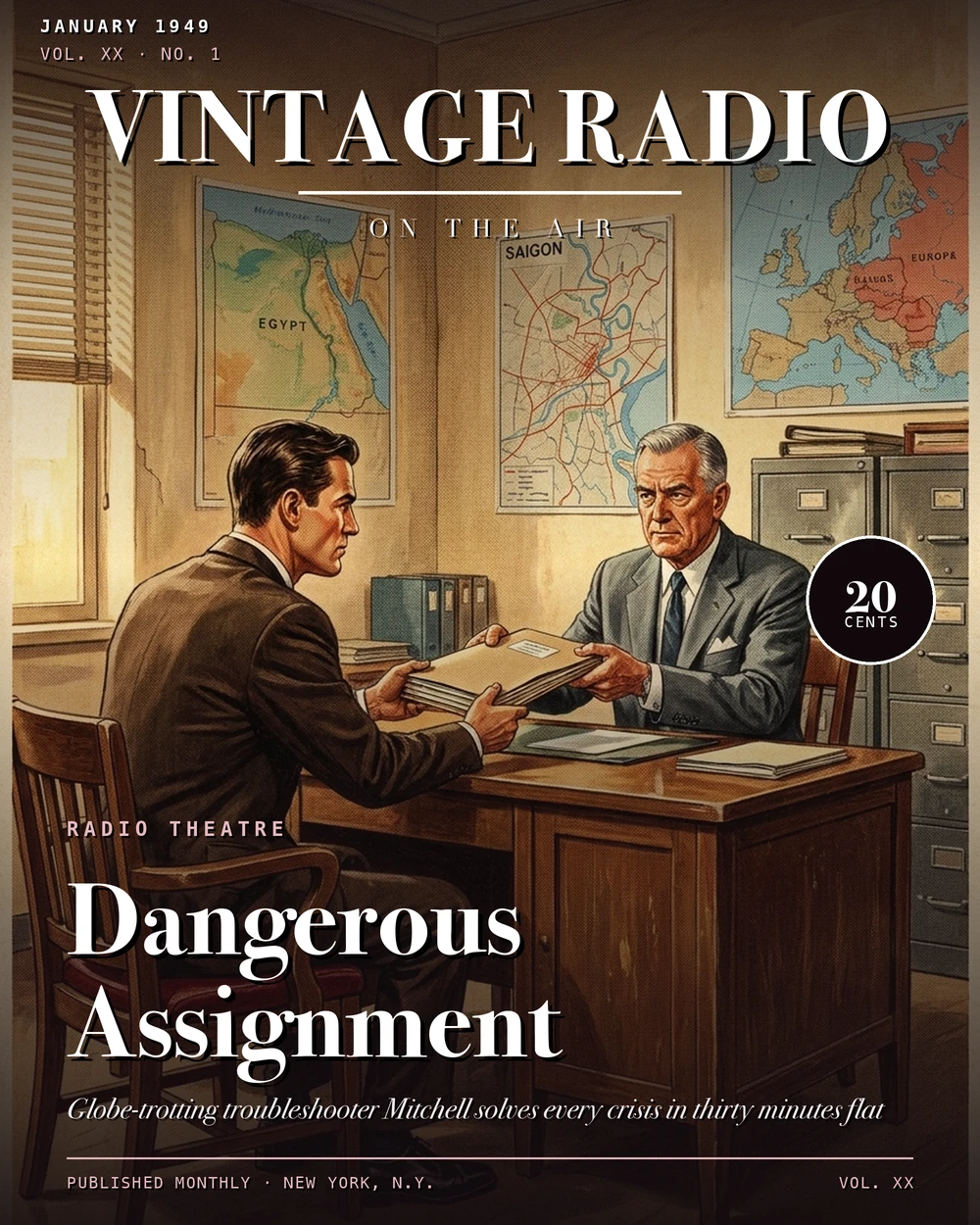
Dangerous Assignment had a formula and it stuck to it. Each episode opened with government troubleshooter Steve Mitchell being called into the office of his nameless boss — known only as the Commissioner — who had word of some fresh crisis breaking out somewhere in the world. Mitchell's job was to go there, find the source of the trouble, and shut it down. Egypt one week, Saigon the next, then on to whatever corner of the globe the writers needed. The destinations changed; the outcomes never did.
Mitchell's cover, in nearly every episode, was that of a suave foreign correspondent for an unnamed print publication — a useful identity for a man whose assignments invariably involved deceit, trickery, and a fair amount of violence before things wrapped up at the end of the half hour. Episode titles eventually settled into a standardized verb-first pattern that gave the game away before the broadcast even started: "Find Szabo and The Briefcase," "Keep Chromite Mine Operating," "Intercept Dr. Korvel Before Opposition," "Retrieve Stolen Atomic Secrets," "Smash Gun-Running Operation." The verbs alone tell you the show.
There was one curious editorial habit worth noting. When Mitchell was dispatched to an allied country, the show named it — Italy, France, Norway. When the destination lay behind the Iron Curtain, the country went unnamed, reduced to "a Balkan country" or "an Eastern European country." Compared to the similar spy series The Man Called X, though, Dangerous Assignment was notably light on Cold War sermonizing, and made less direct reference to fighting Communism than its scheduling neighbor.
Brian Donlevy played Mitchell, and he also narrated in first-person present tense — an unusual choice that gave the stories more of an in-the-moment feel than straightforward third-person narration would have. The problem, as the show's own structure made plain, was that no amount of narrative technique could disguise the fact that Mitchell always won. The predictability was baked in from the start, and the first-person voice never quite overcame it. One veteran researcher of the period called the show "routine Cold War brush fire stuff" made plausible mainly by Donlevy's voice and delivery — a fair summary of both its limits and its appeal.
Getting on the Air
Donlevy himself reportedly brought the show to NBC, and the network developed it cheaply: the summer 1949 pilot run cost $15,000, against $34,000 for Dragnet, $51,000 for Richard Diamond, and $60,000 for Four Star Playhouse that same season. Only seven episodes were produced and broadcast that summer, each running twenty-five minutes — starting with "Thropp Foundation Stolen Relief Supplies" out of Messina, Sicily on July 9 and finishing with "Recover File No. 307" from Zurich on August 20. When no sponsor stepped forward, the show left the air for six months.
It returned on February 6, 1950, with "Find Missing Japanese Weapons." Dangerous Assignment had originally been slated to replace the Martin and Lewis show at 10:00 PM, but ended up in Dave Garroway's old 10:30 Monday slot while Night Beat took the 10:00 hour. Over the next three years it bounced from Monday to Wednesday to Saturday to Tuesday and back to Wednesday for its final months. NBC sustained the show for more than half its run, filling the commercial breaks with promos for other NBC programs; Ford Motors covered a few early episodes, General Mills came on May 10, 1950 as part of a bundle sale with the network, and Anacin, Chesterfield, and RCA Victor took shorter turns. When NBC was shopping the show to potential sponsors in 1951, it advertised the gross weekly cost at $4,117 — against $1,823 for Hollywood Love Story and $8,820 a half hour for Tallulah Bankhead's The Big Show.
Its scheduling neighbor mattered, too. Dangerous Assignment ran immediately before The Man Called X, and the two together gave NBC a full hour of foreign adventure drama. The final NBC stretch, from February 18 through July 1, 1953, trimmed the show to 25 minutes on Wednesdays at 10:35. The last episode, "Find Anthony Targu," aired July 1, with a possible additional broadcast of "Picking Up a Bomb" a week later.
The People Behind It
Producer Don Sharpe and writer Bob Ryf kept the machine running through the NBC years. Herb Butterfield played the Commissioner, Mitchell's perpetually concerned boss, and Betty Moran appeared as the Commissioner's secretary Ruthie — a character the scripts hinted shared some romantic history with Mitchell, though the show kept it as background color rather than a running thread. The supporting cast drew on a roster of capable Hollywood radio players — Betty Lou Gerson, Dan O'Herlihy, Paul Frees, GeGe Pearson, and Ken Peters among them — rotating through the weekly guest roles that the globe-hopping format required. The guest list over the run also pulled in heavier names from stage and screen: William Conrad, Raymond Burr, Richard Boone, and Eddie Cantor all turned up at the microphones.
Mitchell's Sign-On Line
One thing the show did well was its signature opening. Every week, before the plot got moving, Donlevy's Mitchell would deliver the same line: "Yeah, danger is my assignment, I get sent to a lot of places I can't even pronounce, they all spell the same thing, though, trouble." It was economical character work — a voice and an attitude established in two sentences. The audience knew exactly who they were dealing with and what kind of show they were in for.
Brian Donlevy
Donlevy was born Waldo Brian Donlevy on February 9, 1901, in Portadown, County Armagh, Ireland, though some sources gave Cleveland as his birthplace, reflecting an early immigration. As a teenager he lied about his age to enlist in the Army in 1916 for the Pancho Villa Expedition, later served in France with the 32nd Infantry Division during World War I, and picked up flight training that made him an honorary member of the Lafayette Flying Corps. In civilian life he modeled for J.C. Leyendecker — the artist behind the Arrow Collar advertisements — spent two years at the Naval Academy, and then turned to acting, making his Broadway debut around 1924 in productions including "What Price Glory" and "Life Begins at 8:40" alongside Bert Lahr and Ray Bolger.
His film breakthrough came in 1935 with Howard Hawks's Barbary Coast, and he earned an Academy Award nomination for Best Supporting Actor as the ruthless Sergeant Markoff in Beau Geste (1939), losing to Thomas Mitchell for Stagecoach. Later he became the only actor to play Professor Bernard Quatermass on screen twice, in Hammer Films' The Quatermass Xperiment (1955) and Quatermass 2 (1957), to the open disapproval of Quatermass creator Nigel Kneale. Donlevy died of throat cancer on April 5, 1972, at the Motion Picture Country Hospital in Woodland Hills; his ashes were scattered over Santa Monica Bay. His Times obituary in London held that "any consideration of the American film noir of the 1940s would be incomplete without him."
After NBC
Donlevy was also the show's businessman. He bought the television rights from Bob Ryf, who owned the package, and signed Ryf to script the TV version while continuing on radio. No network would put up the money, so Donlevy financed all 39 episodes himself, sold them to individual stations with NBC helping on distribution, and charged anywhere from $75 to $2,000 an episode depending on the market. Herb Butterfield came along as the Commissioner; Bill Karn directed multiple episodes; Al C. Ward and Adrian Gendot picked up much of the writing load alongside Ryf. The syndicated TV run played through the 1951–52 season and turned up on stations into the early 1960s. One contemporary critic dismissed it as "a television version of a pedestrian radio spy series."
In 1954 the show was produced in Australia by Grace Gibson Transcriptions, which redid 52 episodes of the American run with Australian actors and Lloyd Burrell in the Mitchell role; the Australian broadcasts ran from 1954 through 1956 and beyond. The syndicated version opened with a different flavor — a musical sting followed by an announcer rattling off a string of exotic place names: "Bagdad! Martinique! Singapore!" before declaring that wherever "danger and intrigue walk hand in hand" the listener would find Steve Mitchell on another dangerous assignment. It was a flashier entrance than the NBC version, and it leaned harder into the globe-trotting appeal that had always been the show's main selling point.